IISF 2025 to Celebrate India’s Global Scientific Leadership: Dr. Jitendra Singh
 Admin
Admin 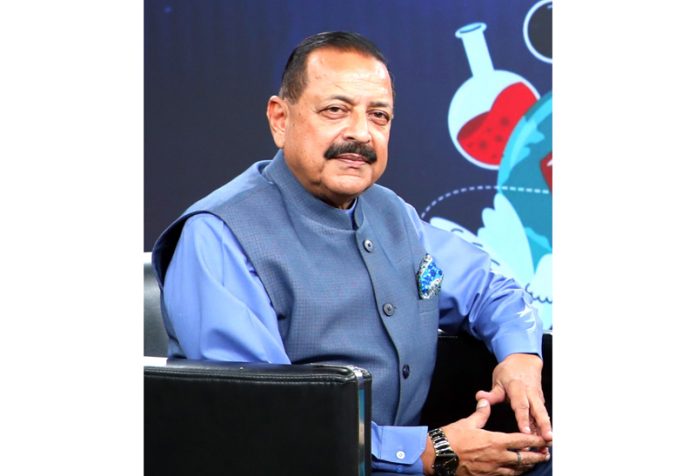
Union Minister of State (Independent Charge) for Science and Technology, Earth Sciences, and Minister of State for PMO, Department of Atomic Energy, Department of Space, Personnel, Public Grievances and Pensions, Dr. Jitendra Singh has described the upcoming India International Science Festival 2025 (IISF 2025) as a celebration of India’s emergence as a frontline global scientific power.
In an exclusive interview with Sansad TV on the occasion of World Science Day, Dr. Singh said,
“This is one of the best times happening for Indian science, and the golden age for Indian youth.”
The Minister noted that this year’s World Science Day theme, “Trust, Transformation and Tomorrow,” aligns with Prime Minister Narendra Modi’s vision of a future-ready India, while the sub-theme “The Science We Need for 2050” encapsulates the nation’s scientific roadmap towards 2047—India@100.
Trust, Transformation and Tomorrow
Dr. Singh emphasized that trust in science grows when research is open, accessible, and inclusive, reaching every household and language. Transformation, he said, happens when scientific discoveries move from laboratories to farms, classrooms, clinics, and startups, creating a tangible link between research and society.
“The tomorrow of 2050 will be safer and sustainable only when the world moves together—from climate to biotech to deep ocean exploration,” he remarked.
India Leading Global Science Diplomacy
Highlighting India’s growing stature in global science diplomacy, Dr. Singh said that India is no longer merely a participant but a leader shaping international collaborations.
“Today, when an Indian astronaut co-pilots the International Space Station or Indian scientists lead global research projects, it reflects India’s scientific capability being acknowledged worldwide,” he noted, adding that modern partnerships are now based on equality and mutual respect, a departure from earlier asymmetrical collaborations.
IISF 2025 in Chandigarh
The four-day IISF 2025, to be held in Chandigarh, will celebrate India’s scientific success stories with global participation, scientific dialogues, panel discussions, and sessions for women scientists, children, students, and startups.
Dr. Singh said that IISF’s goal is to decentralize the celebration of science, taking it to all regions of India.
“In previous years, we have hosted the festival in Goa, Guwahati, and Nagpur. This year, it comes to Chandigarh, symbolizing science for all regions,” he stated.
Science as a Catalyst for Peace
Calling science and technology the “margins of peace and prosperity,” Dr. Singh said that sustainable peace is possible only when nations are connected through scientific progress.
“When nations prosper scientifically, contradictions and conflicts diminish,” he observed.
Bio-E3 Economy: Biotechnology for Environment, Employment, and Economy
Dr. Singh reiterated the government’s commitment to building a Bio-E3 Economy, saying India is at the forefront of the global shift toward renewable and bio-based fuels. He cited the example of producing biofuel from used cooking oil, promoting sustainability and self-reliance while reducing environmental pollution.
India’s biotechnology sector, he said, has witnessed exponential growth—from 50 startups in 2014 to over 11,000 today. The market size has expanded from $10 billion to nearly $200 billion, and is projected to touch $300 billion soon.
“Biotechnology will drive the next industrial revolution, and India is ready to lead it,” Dr. Singh affirmed.